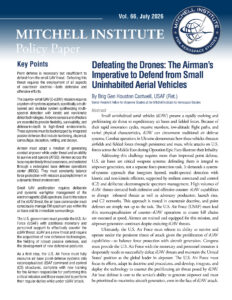
Arlington, VA | July 30, 2026 — The Mitchell Institute for Aerospace Studies is pleased to announce a new entry in its Policy Paper series, Defeating the Drones: The Airman’s Imperative to Defend from Small Uninhabited Aerial Vehicles, by Brig Gen Houston Cantwell, USAF (Ret.), Senior Resident Fellow for Airpower Studies at the Mitchell Institute for Aerospace Studies.
Small uninhabited aerial vehicles (sUAV) present a rapidly evolving and proliferating air threat to expeditionary air bases and fielded forces. Because of their rapid innovation cycles, massive numbers, low-altitude flight paths, and varied physical characteristics, sUAV can circumvent traditional air defense systems. Addressing this challenge requires more than improved point defense. U.S. air bases are critical weapons systems; defending them is integral to airpower generation, not a separate force-protection task.
It demands a system-of-systems approach that integrates layered, multi-spectral detection with kinetic and non-kinetic effectors, supported by resilient command and control (C2) and deliberate electromagnetic spectrum management. High volumes of sUAV threats demand both defensive and offensive counter–sUAV capabilities to disrupt inbound threats as well as adversary production, launch sites, and C2 networks. This approach is rooted in counterair doctrine, and point defenses are simply not up to the task. The U.S. Air Force (USAF) must lead this reconceptualization of counter–sUAV operations to ensure kill chains are executed at speed, Airmen are trained and equipped for this mission, and airpower generation continues despite enduring sUAV threats.
Ultimately, the U.S. Air Force must relearn its ability to survive and operate under the persistent threat of attack given the proliferation of sUAV capabilities—to balance force protection with aircraft generation. Congress must provide the U.S. Air Force with the monetary and personnel resources it desperately needs to successfully defeat sUAV threats and maintain the United States’ position as the global leader in airpower.
The Mitchell Institute Policy Papers series presents new thinking and policy proposals to address the emerging security, airpower, and spacepower challenges of the 21st century. These papers are written for lawmakers and their staffs, policy professionals, business and industry, academics, journalists, and the informed public.
For media inquiries, email our publications team at publications.mitchellaerospacepower@afa.org
Copies of Policy Papers can be downloaded at https://mitchellaerospacepower.org/category/publications/