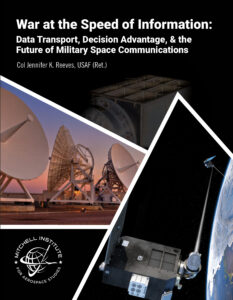
Arlington, VA | October 1, 2026 — The Mitchell Institute for Aerospace Studies is pleased to announce a new entry in its Research Studies series, War at the Speed of Information: Data Transport, Decision Advantage, & the Future of Military Space Communications, by Col Jennifer Reeves, USAF (Ret.), Senior Resident Fellow for Space Studies at the Mitchell Institute’s Spacepower Advantage Center of Excellence (MI-SPACE).
Modern warfare depends on the ability to move, integrate, protect, and exploit data at speed and scale. Existing space communications architectures, however, were designed for an earlier operational era characterized by lower data volumes, more predictable communication flows, and less contested access to space and the electromagnetic (EM) spectrum. At the same time, operational timelines continue to compress, while military sensors, autonomous systems, and proliferated constellations generate unprecedented volumes of data that legacy architectures cannot efficiently transport.
In contested environments, adversaries can exploit these limitations through jamming, cyberattacks, interception, and other forms of electronic warfare, which would degrade decision-making and operational coordination. The resulting communications gap is now an operational and strategic vulnerability. Meeting demand will require more than incremental improvements to existing networks.
Hybrid RF-optical communications architectures offer a scalable path toward greater transport capacity, resilience, and survivability. Reducing the amount of data that must be transmitted is as important as increasing transport capacity. Onboard processing, artificial intelligence (AI), edge computing, data compression, and distributed data-management architectures can reduce transmission burdens while accelerating the delivery of mission-relevant information across operational networks. A hybrid approach, coupled with intelligent onboard data processing and continued RF modernization, can expand transport capacity, improve network resilience, and sustain U.S. decision advantage in future conflict.
The Mitchell Institute’s Research Studies serve as an authoritative avenue for innovative, in-depth, insightful, and effective ideas and solutions for strengthening America’s aerospace power.
For media inquiries, email our publications team at publications.mitchellaerospacepower@afa.org
Copies of Policy Papers can be downloaded at https://mitchellaerospacepower.org/category/publications/