In this episode, Heather “Lucky” Penney and Brig. Gen. Houston Cantwell, USAF (Ret.) discuss the small UAV threat and how the Air Force is fighting back with Col. Alfred Rosales, Commander of the 319th Reconnaissance Wing, and Lt. Col. Cody Moore, ACC Directorate of Operations A35 division chief. It’s no secret: small UAVs are driving massive battlespace change. From Ukraine to the Middle East, cheap and highly adaptable UAVs are attacking at scale. Traditional air defense systems are strained trying to meet the threat. We talk about the Point Defense Battle Lab at Grand Forks AFB, layered sensing capability, and training airmen for the counter-UAV mission.
Guests
 Brig. Gen. Houston Cantwell, USAF (Ret.)Senior Resident Fellow for Airpower Studies, Mitchell Institute
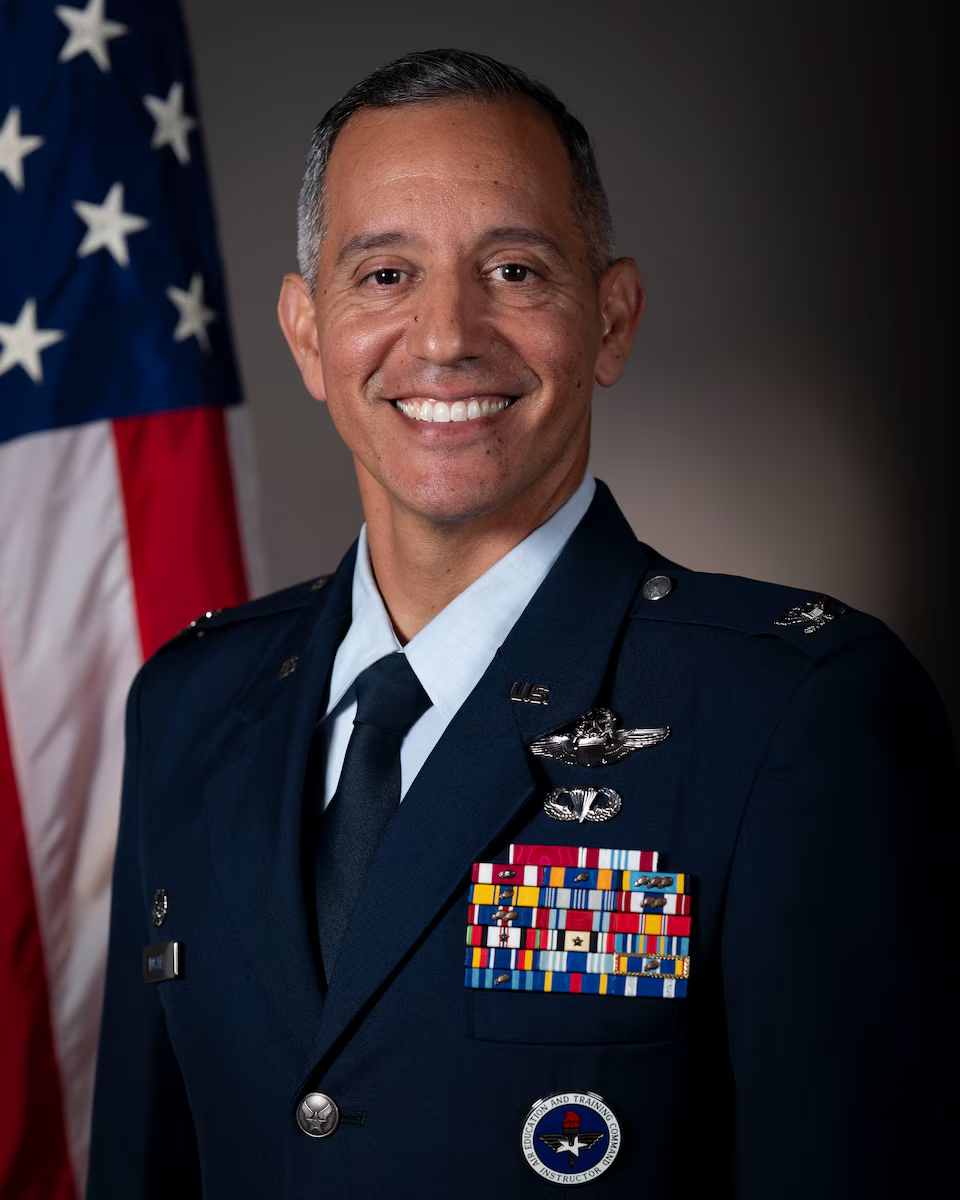 Col. Alfred RosalesCommander, 319th Reconnaissance Wing
 Lt. Col. Cody MooreACC Directorate of Operations A35 Division Chief
Host
 Heather PenneyDirector of Studies and Research, The Mitchell Institute for Aerospace Studies
Transcript
Heather “Lucky” Penney: [00:00:00] Welcome to the Aerospace Advantage podcast, brought to you by PenFed. I’m your host, Heather “Lucky” Penney. Here on the Aerospace Advantage, we speak with leaders in the armed forces, industry, and other subject matter experts to explore the intersection of strategy, operational concepts, technology, and policy when it comes to air and space power.
So small UAVs, what most people call drones, are proving their effectiveness in the modern battle space each and every day. So Ukraine, Russia, Iran have been using them in increasing numbers with lethal effects for years. And whether it’s the small FPV drones on the front lines in Ukraine, the daring spider web attack by Ukraine and Russia, or Iranian Shaheeds and Russian Gerans, small UAVs are changing the dynamics of the battle space and some long-held assumptions regarding air base defense.
These Group one through three drones uncrewed air vehicles can range from the very small and very slow to 1,300 pound aircraft that can fly up to 250 knots, have evolved from rudimentary to now highly [00:01:00] capable sensor shooter weapon systems. These small UAVs are prolific tools that are affordable in high volume to nation states, proxies, and non-state actors, due to the low cost and the availability of navigation, data links, control systems, and programming and processing.
Importantly, these small UAVs are easily adaptable, so they’re changing rapidly in response to countermeasures. And in Ukraine, the relevance of a specific drone system can be as short as two months, something well inside our US acquisition cycle. So these small UAVs are now lethal threats to our bases because they stymie our traditional air defense systems.
They’re evasive, they can maneuver in unpredictable ways, and they’re increasingly precise in their targeting. They’re built from a wide range of materials, and they fly varied profiles from over 10,000 feet or even below 100 feet, and at a wide range of airspeeds. Some are electric, while others use gasoline propellers, and others use small jet engines.
So their sizes, their speeds, their altitudes, and propulsion methods [00:02:00] all make them very difficult to detect, track, and to engage. In response to this threat, new sensors and kinetics and non-kinetic effectors have hit the market. But any effective defense measure will require more than just new hardware.
Mitigating this threat requires a combination of new equipment, training, and organizational concepts. So to learn more about this, we’re honored to introduce Colonel Alfred “Slick” Rosales, the 319th Reconnaissance Wing Commander. The 319th is located in Grand Forks Air Force Base and hosts Air Combat Command’s Point Defense Battle Lab.
So Slick, it’s great to have you with us.
Col. Alfred Rosales: Great to be here, Heather. Thank you very much for having me.
Heather “Lucky” Penney: We’re also pleased to welcome Lieutenant Colonel Cody Moore, who’s working point defense policy matters in Air Combat Command’s Operations Directorate, the A3. Previous to his current position, Lieutenant Colonel Moore was the ACC Point Defense Task Force commander, so he brings great experience and insight to our conversation.
Cody, thanks so much for being here.
Lt. Col. Cody Moore: Yeah, thanks so much for the invite, Heather. It’s, a pleasure to get to keep working on this, both at the tactical level [00:03:00] as a part of the PDTF, and then now at the policy level here at ACC.
Heather “Lucky” Penney: Fantastic. And finally, joining us is our very own Brigadier General Houston Cantwell.
So Slider, you recently released a report on air base defense and counter-UAV efforts. Awesome job, and we’re looking forward to learning more about your findings. We’ll include a link to that rollout, in our show notes. But we do want to mention that the views of this paper reflect those of the Mitchell Institute and should not be construed to represent the position of the Department of the Air Force.
Brig. Gen. Houston “Slider” Cantwell, USAF (Ret.): Thanks, Lucky. It’s great to be here. I’m excited to talk about the topic.
Heather “Lucky” Penney: Okay, so Slider, you just finished a report, so help us frame this challenge. You know, as I mentioned in the opening, small UAVs are causing tremendous damage in Ukraine, Russia, and across the Middle East. What are you seeing?
Brig. Gen. Houston “Slider” Cantwell, USAF (Ret.): Where to start? This topic is so relevant. Small UAVs are being so widely used, and they’re evolving literally before our eyes. I’d say in Ukraine, I describe the situation as massive, innovative, and diverse. If you look at Ukraine, they’ve claimed to have shot down [00:04:00] 33,000 drones in March of this year alone.
Heather “Lucky” Penney: That’s eye-watering.
Brig. Gen. Houston “Slider” Cantwell, USAF (Ret.): It, it really is. So they’re seeing huge numbers, and the defense seems to be evolving as fast as offense. And they’re rapidly iterating back and forth like a cat and mouse between the two. Whoever can evolve faster has the upper hand. And then there’s so many different kinds. They use a wide range of communication systems. There’s a typical RF control. Some use Starlink. Others are on cell phone LTE networks. And you’ve got some on fiber optic cables. These cables are longer than 10 kilometers, so things- that we’ve never even seen here in the US. They’re at low altitude, they’re at medium altitude, and they’re constructing them from just about anything.
You got wood, carbon fiber, styrofoam, aluminum. And I bring all this diversity up because it really makes them difficult to track, and then it makes them really difficult to engage.
Heather “Lucky” Penney: Yeah, and it also means that you can’t have a single defense system because they are so different and so varied in terms of their behaviors, their control mechanisms, and their construction, that one thing isn’t going to be a panacea in terms of defense.
Brig. Gen. Houston “Slider” Cantwell, USAF (Ret.): Absolutely.
Heather “Lucky” Penney: so why are [00:05:00] they so difficult to stop?
Brig. Gen. Houston “Slider” Cantwell, USAF (Ret.): Okay. First, the threat is coming in higher numbers than we’ve ever seen before, so there’s a simple numbers game.
Heather “Lucky” Penney: Yeah. A numbers game- I mean, 33,000, like, that’s overwhelming mass.
Brig. Gen. Houston “Slider” Cantwell, USAF (Ret.): Yeah, I mean, when we think of drones, we think of, like, these single quadcopters coming over, onesie, twosies.
But the Ukrainians are seeing just mass numbers, so that- in itself is difficult. We just need more interceptors, more ability to stop these large numbers. Then there’s the low airspeeds and the low-altitude operating areas. That makes it difficult for modern radars to dig them out of ground clutter or to differentiate from things like birds- because they’re operating at the same airspeeds as some of these birds. And then finally, you’ve got their infrared signatures. We’re used to heat signatures from traditional aircraft because they- have jet motors, and these allow our infrared missiles to track targets, but many of these small UAVs, they don’t emit, much heat because they’re using.
Heather “Lucky” Penney: They’re, like, battery operated.
Brig. Gen. Houston “Slider” Cantwell, USAF (Ret.): I mean- They’re using batteries and electric motors, not jet engines, and so- [00:06:00] it’s really difficult to track them.
Heather “Lucky” Penney: Well, this means, like, for example, um, you know, acoustics are one of the ways the Ukrainians are putting together a way to be able to identify incoming threats with cell phones that are literally listening to the specific frequencies of those propellers.
Brig. Gen. Houston “Slider” Cantwell, USAF (Ret.): Yeah, exactly, because they’re flying in that low-altitude regime. They set up these acoustic sensors throughout their- country and allows them to hear them before they come into, you know, their strategic targets.
Heather “Lucky” Penney: Yeah, I mean, it really reminds me of World War I and the pace of measure and countermeasure in terms of air combat, and so we’re seeing this just with a different kind of regime and in different types of technologies.
Brig. Gen. Houston “Slider” Cantwell, USAF (Ret.): Yeah.
Heather “Lucky” Penney: So what about the existing air defense systems? And we’ve, we’ve already kind of alluded, I think, to this, you know, regarding why Patriot and THAAD systems are just not appropriate for this particular threat, but don’t they still play an important role in defending our bases?
Brig. Gen. Houston “Slider” Cantwell, USAF (Ret.): Yeah, so a couple points on this.
Number one so we look at Russia. They have a massive inventory of very capable surface-to-air missiles, yet despite this [00:07:00] formidable stockpile, if you follow the news, Ukrainian small UAVs continue to destroy Russian infrastructure across their country. So these systems like THAAD and Patriot, which have similar capabilities to what the Russians have got, they remain relevant for our traditional air threats. When you look at ballistic missiles, traditional manned aircraft, very relevant, very important. But-
Heather “Lucky” Penney: And they will be. They will continue to be so.
Brig. Gen. Houston “Slider” Cantwell, USAF (Ret.): They will remain. Exactly. They will remain that. But any small UAV defense is gonna have to dovetail into that existing Army air defense construct, and you’re gonna have to have the information sharing, figure out what the authorities are, figure out the command and control seams. But all that has to come together, small UAV defense and then what the existing Army air defense is.
Heather “Lucky” Penney: Yeah and we’ll talk more about the attributes of what a small UAV defense is gonna require- in terms of cost exchange and numbers and magazine depth and all of that. But more on that in a, in a bit.
I’d like to swing over to our guests. So Lieutenant Colonel Moore recently Lieutenant General Neimi, the [00:08:00] Headquarters Air Force Deputy A5/7, so Air Force Futures, he described many of the current small UAV defense efforts as ad hoc and reactionary, and he also described the small UAV threat as urgent and mentioned that Air Force Chief of Staff has made the decision to get back in the business of defending air bases from air threats, and I think we all understand why. So how is Air Combat Command supporting General Wilsbach’s directive?
Lt. Col. Cody Moore: So I think General Cantwell did a great job of highlighting the urgency of this problem set. We’re seeing this occur in Ukraine. We’re seeing this occur in Central Command with our current ongoing conflicts. We’ve seen the rise of the number of systems being produced by China. This isn’t going away, and this is not something that we can create an ad hoc solution to. So I … General Wilsbach has made the choice to professionalize this mission, and that’s really where ACC is [00:09:00] leaning into how do we create the airmen to do this job across the world? How do we organize our forces to be ready for this? How do we create the airmen with the specific skill sets necessary to build that layered defense approach? How do we train those airmen? What are the core competencies that those airmen need to be capable of? Where do we train those airmen? And then finally, what equipment do we need to give them to be capable of providing a proper defense? And, as you’ve already alluded to, that is layers. All the way down to the shotgun, small arms solution that we’re seeing employed sometimes in the Ukrainian fight, out to that larger defense against a Shahed-style drone many, many miles away. We have to create that layered defense approach. So ACC is very proactively leaning into all three pieces of that [00:10:00] puzzle.
Heather “Lucky” Penney: Now, I’m so excited to hear you saying that because for the past 30 years or more really since the fall of the Soviet Union, we’ve been able to treat our air bases like they’re sanctuaries. And so professionalizing and making this, a real mission with the equipment, the organization, the training, the manpower, that specialization, I think is absolutely essential because if we’re gonna be able to generate combat air power, we have to be able to defend our bases and operate, through attack.
So one of Air Combat Command’s major efforts has been the creation of the Point Defense Battle Lab at Grand Forks Air Force Base. So Colonel Rosales, can you tell us about the Battle Lab and why it’s such an important part of the Air Force response to the small UAV threat?
Col. Alfred Rosales: Absolutely, Heather. I appreciate giving us an opportunity to talk about the Battle Lab. Here at Grand Forks Air Force Base and on our reconnaissance we were excited honestly to join the Point Defense Task Force up at Air Combat Command, and what General Spain has referred to as bringing the future forward. Figuring out not just at the Air [00:11:00] Combat Command staff level, the crucial policy work that needs to be done, figuring out how we train, sustain, and equip our forces, but how do we iterate to get there, to have good, a, a good way forward.
And so General Spain had asked many wings to figure out who can do this the best, where can we do it now, and there was many opportunities, many wings that could execute this. But what we’re doing here, Battle Lab, think of it more than, a handful of people that came from Air Combat Command.
You need to think of the Battle Lab at the moment as a whole wing approach. It is the entire reconnaissance wing, Grand Forks Air Force Base, a variety of Air Force specialty codes, mission sets, figuring out what it looks like to iterate on a variety of topics that need to be addressed at the Point Defense Task Force level.
And so we’re not a new restricted airspace test and experimental base. It is, trying to figure out how we use commercial [00:12:00] off-the-shelf technologies, existing vendors in the United States that would like to allow our Airmen to use their equipment to address exactly what we’re talking about and what General Cantwell had talked about in terms of base defense.
So that’s, that was the the foundation of why we’re, we were picked as the Battle Lab.
But we weren’t alone. I’ll give you just this one 10-second little pitch we were also asked with our TFI partners, the Air National Guard, the 184th Wing, Colonel Joe Deeds and the team there, they are providing other unique Air Force specialty code expertise, the air battle managers and, and a variety of other skill sets that we can use to, to make it an actually effective I’m gonna call it approach to maintaining, I’m gonna say tactical air superiority over our bases.
Heather “Lucky” Penney: So that’s like super cool. I mean, not only that you’re doing that iterative approach, but really how you’re merging commercial off-the-shelf acquisition traditional and new defense partners, as well as the Air National Guard and the air battle managers, [00:13:00] because ultimately it’s gonna have to get, in my mind in the hands of the operators, of the airmen, to really find out how this is going to really dovetail and work together.
And as you’re iterating that, that’s an important piece because as we’ve seen in Ukraine as well as the Middle East, this evolves so rapidly that that kind of creativity and a really more of an institutionalized approach to innovation, that rapid innovation is gonna be crucial. So how are you all integrated with JIATF-401, the Joint Interagency Task Force that’s been charged with the counter small UAS mission?
Lt. Col. Cody Moore: So a lot of the innovation work that we’re completing at the Battle Lab and at the Point Defense Task Force feed potential solutions to the Joint Interagency Task Force. You know, we have a piece of this puzzle, which is the Air Force solution, and JIATF is charged with that interagency connectivity.
So sometimes we identify solutions, like Colonel [00:14:00] Rosales pointed out, commercial solutions through our Battle Lab that feed JIATF with possible solutions that end up on their marketplace. That’s the equipment side of it. The other side of it is JIATF is really responsible for a lot of that interagency communication that makes this problem so hard. Working with the FCC, with Air Traffic Control, with Homeland Defense, with the FBI, and with the other services. So we work hand in glove with JIATF to say, “Hey, here’s the Air Force piece of the solution,” but also how it nests within that larger joint organization.
Heather “Lucky” Penney: So that’s really interesting. I’d like to dig into this a little bit more. First of all, I didn’t realize that JIATF was bringing together a marketplace that that could have solutions that are proven out by one service but that another service could find useful and applicable to their problem set, too.
Lt. Col. Cody Moore: Absolutely. This is not an Air Force problem. This is a [00:15:00] whole of government problem, and our solutions are whole of government solutions. There’s no reason for us to identify something and the Army not be able to use it.
Heather “Lucky” Penney: So how are you also integrating the layers of sensing and command and control that will be absolutely essential, especially in expeditionary operations?
Lt. Col. Cody Moore: So you have to have, General Cantwell well talked about this already a little bit. You have to have layers of sensing capabilities depending on the size of the threat. How you identify a small group one drone is significantly different than how you identify a ten-foot group three. So you have to have passive sensors. You have X-band radars. You have air traffic control systems that are integrated into your C2 structure, and it’s that layered sensing and layered communication command that will drive a total solution. So [00:16:00] one of the biggest challenges here is trying to bring in those civilian agencies and local law enforcement to say, “Hey, I saw it outside of my base threat zone or out of my base defense zone. This is a local law enforcement problem.” How do we communicate what we are seeing to civilian agencies and to the larger homeland defense approach? That is the key to success.
Brig. Gen. Houston “Slider” Cantwell, USAF (Ret.): Yeah, one of the challenges that you’re bringing up here is information sharing. You can have all these different sensors from different agencies and organizations, but if they can’t share that common operating picture, then it does nobody any good.
Heather “Lucky” Penney: So we’re gonna get back to expeditionary bases, but you know, I really am curious to dive more into JIATAC 401 and what you’ve mentioned regarding the interagency coordination for defense here in the CONUS for our domestic bases. ‘Cause it’s one thing if our forces are in a relatively isolated area away from [00:17:00] civil populations that are in theaters, and quite a different problem set, for example, if we were defending Joint Base Andrews on the outskirts of downtown DC.
Col. Alfred Rosales: Okay. Yeah, no, that’s a great point in how we’re, what are we doing in terms of the, the whole of community approach. You mentioned, Joint Interagency Task Force 401 and how we’re working with them. And Colonel Moore mentioned a lot of goodness on how we are aligning with them. We are lockstep with them, not just at the Air Combat Command level, but also at the tactical level here at the wing. We are consistently on a weekly and a monthly basis walking through what it does with multiple exercises that we do here at, in Grand Forks. Our pacing for exercises for a variety of vendors is almost weekly. And so JIATF 401 is part of that plan. Including future, exercises that, some folks know about, like the technology experiment, the T-Rex. That’s funded and supported through the Under Secretary [00:18:00] of Research and Engineering.
I will say that JIATF 401 is with us on that at the tactical level. So there, there is a variety, of integration, but I don’t, think that’s the whole picture. I think you need to bring it back a little bit to what Colonel Moore had mentioned in terms of the civic leaders.
Now, here at Grand Forks, we were chosen for a variety of reasons, but I think the probably the main reason is this drone, counter drone ecosystem, they have built around here. Which is a whole of community approach to this counter drone, drone folks here. I … It is not just Grand Forks Air Force Base and the Point Defense Battle Lab.
We’re talking the Grand Sky program, which is an enhanced use lease that is at Grand Forks Air Force Base. We could talk more about what actually the Air Force at large has agreed with Grand Forks County to partner with this enhanced use lease in ways that is helping us win and bring the future forward, like I said before, quicker with this joint use agreement that allows, uh, me to directly, be the representative, with the [00:19:00] Grand Sky, leadership. Grand Sky is the largest, or, well, at least the first and one of the largest drone, counter drone innovation research parks in the country, but also other things. Northern Plains Test Site, is a North Dakota state initiative to figure out how we do surveillance even beyond the fence line of small drones.
And I mean surveillance like Federal Aviation Agency type of surveillance. How do we do beyond visual line of sight for drones of class I, II, III, drones? They have put a substantial amount of money in the last few years working to validate that beyond visual line of sight, which we capitalize on with the Point Defense Battle Lab and with our Grand Sky partners, with University of North Dakota’s Aerospace.
Man, I can go on forever on that. The National Guard here in North Dakota. They have partnered with us with Camp Grafton and the Army. The Air National Guard of North Dakota, the 119th down there in, Fargo, we have partnered in ways to accelerate what [00:20:00] we’re doing and what General Spain and CONAM has asked us to do.
And it is, it has honestly gone off into some great iterating, I’m gonna call it, and exercising. That’s my initial swing at it.
Heather “Lucky” Penney: I can’t wait to talk more about that from Grand Sky to the beyond line of sight to the surveillance and the Northern Plains Test Site. So I want, I definitely wanna hear more about that.
But before we go there, one of the things that, that we talked about was the interagency coordination, that is necessary for defending our bases here in CONUS because you know, I remember the drone incursions over Langley, and there wasn’t really anything we could do about that. So how has that changed, and what additional coordination, authorities, and integration have we pioneered, and do we still need to put into place to prevent something like a spider web here at home?
You know, and what other special factors do we need to consider regarding that kind of jurisdiction when conducting CONUS operations?
Lt. Col. Cody Moore: So the Department of War has put into place additional [00:21:00] authorities for our base commanders to defend themselves. That is a big piece of the puzzle. We’ve bolstered a lot of our defensive capabilities- at our CONUS installations to be able to detect, track, ID, and defeat those systems, and then we’ve done a lot of education to our base forces, not only at the leadership level for the wing commander to say, “Hey, what are my authorities? How do I deal with this?” But also all the way down to your individual airmen receiving training on how to do that notification of what they see. Is it a bird? Is it a plane? Is it a drone? That can be just as important to make sure that we do that proper identification. So we’ve done a lot of work since the Langley incursion to prepare our forces for any additional threats and we are continuing to grow those capabilities through the kind of thing you see at the battle lab.
Brig. Gen. Houston “Slider” Cantwell, USAF (Ret.): Yeah, Cody, I’ll pile on. During my [00:22:00] research, I can’t emphasize the importance of that training for the airmen around the base. Downrange a lot of those airmen didn’t have that type of training, but were then subsequently informed, “Hey, be aware of the drone threat.” And without training, they began reporting any light they saw at night, and then the BDOC became overwhelmed with all this basically false reporting because airmen were just, on heightened.
Heather “Lucky” Penney: They didn’t know how to ID.
Brig. Gen. Houston “Slider” Cantwell, USAF (Ret.): Heightened awareness, and they’re seeing lights, you know, off 50 miles away, and they’re like, “That could be a drone. I gotta report this.” And so what you just said about the training is so important about this, with the airmen.
Heather “Lucky” Penney: And also for our civil bases, the, the ones that are in CONUS we also have to worry about FAA, civil law enforcement and other federal agencies.
And, and for our permanent bases that might be overseas, that would be even more complicated, because we don’t necessarily own from a federal perspective the law enforcement and other things. And so, how are we, at least here in CONUS, how are we [00:23:00] integrating and improving communication and authorities with those municipalities, the counties, the states, and, and the federal layer?
Col. Alfred Rosales: Yeah, this this is Slick here. I’ll make a, a small point to, to add on what General Cantwell said. In terms of the training and what Colonel Moore said in terms of how we’re trying to address that at overall at Air Combat Command. But at the wing level, one of our go-dos here at the, at the battle lab, and I’ll call it the reconnaissance wing, is to figure out that next step.
It’s not just the fielding of new technologies to provide that information or those tactics and the techniques and procedures we write for every one of those pieces of vendor equipment, and how they can work with other people’s vendors’ equipment. Whether it be non-kinetic and/or kinetic layering as, as previously mentioned. I think a big point is figuring out how we can do that command con- command and control beyond the base defense operation centers and incorporate a variety of air traffic control elements. [00:24:00] Here in Grand Forks, we just so happen to be organized here that we manage both the Air Force base’s airspace with both approach as well as the international airport for Grand Forks.
We manage that as the Air Force base for both, both fields. And so we have a wider view using not just our digital airport surveillance radar, but a variety of other opportunities as well. So thinking through the training beyond the scope of initial reporting, but working through, once we get that initial reporting, what does that timeliness of response look like, how do we continue to maintain our tactical superiority that we already have and continue to grow it as our adversaries continue to iterate themselves?
And so we’re working through that now so we can get the right information to Air Combat Command on what this should look like purely from a wing organization structure as well. So more to follow on that, but that is also a go-do of this wing beyond the [00:25:00] battle lab’s efforts.
Lt. Col. Cody Moore: And this is why the Point Defense Battle Lab approach is not only so important, but why the Three Nineteenth is getting this right.
The Point Defense Task Force has been focused on the individual airmen responsible for these point defense systems. Colonel Rosales and the Three Nineteenth are focused on the whole-of-wing defense for point defense. So all the way from that air traffic control integration down to your maintenance individuals doing the reporting and the spotting and your integration with security forces and local law enforcement.
It is a whole-of-wing approach to this problem.
Col. Alfred Rosales: Yeah, no. In terms of the point defense battle lab and the whole wing approach that we are taking it and we were directed from General Spain at Air Combat Command and the Number Air Force, the 16th, we were trying to figure out how we build out our exercise tempo to get some [00:26:00] early wins. And so in that, I will say we have, grown from in the last year we have been given this mission from finding and fixing type of vendor equipment just to find these small drones, class one, two, and three up to 250 miles an hour. Not just at our fence line or how do we work the Federal Aviation stuff beyond the fence line, to now we are going to kinetic operations.
And how we do that in an airspace that is quite frankly, not restricted that we typically do when we do developmental tests, I told you we do not do developmental tests here. We are, we are exploring how we use commercial off-the-shelf to generate tactics that we could potentially give so that the Air Force at large, at scale can procure these items with confidence. And so that’s kind of where we’re headed and I will say the full spectrum and it’s, it has been public released. There’s news reports that directed energy laser- lasers are being installed here, and they are in literally in the near [00:27:00] horizon future being in our exercises. Microwave energy effective weapons. Those things are on the horizon coming here to Grand Forks because of the community approach. It is not a Air Force with the flag running in the same direction, it is running with the flag alongside our state officials, our city officials, the Federal Aviation Agency, not just the regional, but at the head the headquarters level walking lockstep with us.
In fact, I think that an interesting win that i- is unrelated to non-kinetic and kinetic weapons our tactics and techniques and procedures we have drafted and submitted up to Air Combat Command, that propose on how other wings Can push and challenge the policies of the states and the federal governments for a variety of RF and GPS jamming equipment.
How do you build trust with the, your local, state, and federal officials to get them on board to figure out how we… when we [00:28:00] procure these weapon systems, how do we implement it from a policy level? Those TTPs have come from this base, from this battle lab in the recent in the recent past. That’s a huge recent win that I can share with you.
Heather “Lucky” Penney: That’s so exciting, and also so important, especially because here within the United States, the partnership, the collaboration, coordination with civil authorities, whether or not that’s your local townships, again, the municipalities, or even the federal, element of law enforcement, and agencies like the FAA, is gonna be really crucial.
I wanna go back, though, to something that, that y’all had mentioned regarding the training of airmen. And clearly you’re doing a lot of that Colonel Rosales, there at the battle lab. But Houston, you just went down to Fort Sill recently to look at the training operations that the Army is doing there for the entire Department of War. What did you see there and what did you learn?
Brig. Gen. Houston “Slider” Cantwell, USAF (Ret.): Yeah, so the Army runs the Joint Counter-UAS University- at Fort Sill, and they’re doing tremendous work. They have several courses. They’ve got a planner’s course. They’ve got an operator’s course. [00:29:00] These are courses that are, like, two to four weeks long. And they’ve got a throughput of students coming through all, all year. And they serve the entire joint community. And they actually said, you know, “We get a tremendous number of airmen coming through,” but the challenge they’ve got is overall throughput. They just can’t keep up with the demand.
And so after I was, you know, thinking about, wow, what are the other opportunities for more throughput, I was like, “Where could the Air Force, you know, set up their own counter-UAS university?” And I was thinking, wow, the the Joint Counter-UAS Battle Lab would be one opportunity. But it sounds like Slick and team have already got some of that, you know, going. I just don’t know how much of the formal curriculum that’s at Joint Counter-UAS University would be applicable to move up to Grand Forks.
Heather “Lucky” Penney: Yeah, because it sounds like Grand Forks is really, you know, what you’re doing there at the battle lab is really pioneering a lot of the TTPs.
Cody, how are we seeing the tactical element, everything from, you know, identification, like positive identification as well [00:30:00] as response and feeding into the command and control, system so that you can appropriately counter these? How are you sharing that across the Air Force?
Lt. Col. Cody Moore: So the, the training piece of this is so critical. Getting the lessons learned from Ukraine, from, uh, the Middle East, and feeding that into the Joint Counter UAS University pipeline and how we train our airmen is how we’re going to succeed. So we have created a mobile training team that supports the airmen at their home station. The Joint Counter UAS University is going to be the Air Force’s long-term solution for training with potential growth at places like the battle labs, but the Joint Counter UAS University is going to see significant expansion for our airmen. In the interim, we have a mobile training team as a part of the Point Defense Task Force that goes out to bases and teaches the [00:31:00] fundamentals of point defense in areas of air traffic control, command and control, security forces and base defense, and maintenance and sustainment.
So we are building that foundation and meeting the airmen where they live, and that will feed the larger approach at, the JCU at Fort Sill.
Heather “Lucky” Penney: That’s fantastic. I really love hearing about how ACC is leaning into this challenge, how you’re leveraging your operational units here in the States to really be thought leaders and develop the TTPs at a pragmatic operational level, and then how you’re spreading that, across the bases and airmen to make sure that they’re appropriately equipped.
Because we can’t wait for an institutional solution, so how you’re creating that training availability is really creative and necessary and just, just goodness.
Lt. Col. Cody Moore: I’ll even take you a step further if you want.
Heather “Lucky” Penney: Yeah?
Lt. Col. Cody Moore: Which is that, you know, the, the training [00:32:00] isn’t simply just demoing the ability, right? It isn’t just how do I use the equipment. In order to be really skilled in this you need an adversary force. So we’re building aggressor capabilities, a red team out of the Kansas Air National Guard point defense battle lab that will be visiting bases and helping teach that red on blue force to do that whole airman training.
Not only the folks that are sitting in that BDOC, but the reps and sets for the wing as a whole to be prepared to defend against the threat.
Heather “Lucky” Penney: That’s…
Col. Alfred Rosales: I can even go one further than that.
Heather “Lucky” Penney: Yeah, that’s amazing. Go ahead. Please do.
Col. Alfred Rosales: I can even go one further than that. I will say, build upon that, I’m gonna call it adversary red air as he mentioned, Colonel Moore mentioned it. We are even expanding beyond that with our community partners. Folks like, in academia, University of North Dakota’s Aerospace Department has generated and incorporated into our exercising on how they can help us be part [00:33:00] of that red air idea. And in those actually I, I’d like to highlight that throughout the UND’s Aerospace’s efforts, it has triggered some, some questions on terms of how does it work with the different policies from the Federal Aviation Agency in terms of drone training?
And then there’s and that has spawned into other parallel efforts here that have talked about, from the Northern Plains Test Site in North Dakota, how they can help draft what it looks like for class one to three training certifications and how we can continue to expand our efforts here and on state side in terms of how we manage, beyond defense, thinking purely to surveillance.
If I’m a just, let’s just shift gears a little bit. If you just talk surveillance, if you can get that right, you know what’s supposed to be airborne. Maybe then we can identify beyond the fence line, as General Cantwell said, what should not be there. And so that, that’s also a, an initiative that that could play a part to our overarching [00:34:00] approach, uh, as the Air Force moves after continuing to maintain our tactical superiority over our bases.
That’s all I got on that.
Heather “Lucky” Penney: So Slick, it’s really exciting to hear how you’re talking not just about the training, but about how that long look and that, that layered sensing, is gonna give you better situation where I know so you have the appropriate response.
And Slider highlighted the importance of, um, revamping the base defense operations center and moving its current focus from ground security to this broader battle space awareness surrounding our bases, and how this layered defense should extend perhaps even hundreds of miles from the base. And you had also mentioned, you know, beyond line of sight as well.
And certainly, any airbase command and control system has to integrate into a larger theater-wide construct, both whether or not that’s a theater, dealing with the FAA or, if it’s gonna be expeditionary. How are you all looking at this challenge as you’re refining your operations there at the, at the battle lab and thinking about then how you export that [00:35:00] to expeditionary airbases as well?
Col. Alfred Rosales: That’s a, that’s an awesome question. I’ll tell you right now as you and I are talking, the, we are iterating with exercises that have spawned this idea of the need for further expanding our common operating picture that we have of, I’m gonna say the surface to not just four hundred feet, the surface all the way up for class one to three drones.
And what does that look like? And so we have, we figured out what that common operating picture sharing should look like, and we have worked alongside the FAA to see on both sides what the Northern Plains Test Site is doing with their, we call it their beyond visual line of sight architecture. And how we can pump that into the base’s feed where our air traffic controllers can see it.
And if our air traffic controllers can see it, then maybe we have an opportunity to do what General Cantwell has proposed in his paper in terms of redefining what the base defense operations centers could look [00:36:00] like, beyond the scope of where they are now. Which I honestly from just purely as an installation commander, I think that is an ongoing healthy way. We always look at it as an Air Force, how do we see our adversary? How do we modify our command and control, continue to respond in a timely fashion so we can move at the at the pace to continue to win. I think that’s really where we’re at. We’re taking really an approach with the community by trying to just do it internally as an Air Force wing.
Lt. Col. Cody Moore: At the policy level, we’re also looking at incorporating an Air Defense Operations Center into that BDOC model. So the BDOC needs to expand its view as Colonel Rosales just mentioned, to be inclusive of that area air defense approach. We’re looking at that and working with our partners in the Pacific, Europe, and Central Command to build a foundational Air Defense Operational Center capability.
How does that [00:37:00] apply to our stateside bases? And then how would we expand that for additional threats when it becomes an expeditionary capability?
Brig. Gen. Houston “Slider” Cantwell, USAF (Ret.): Yeah, that’s music to my ears, team. I, in my report, I highlighted the deficiencies of the current BDOC, and to know that you’re taking this on, you’re taking this head-on is exactly what the Air Force needs to be doing. It just can’t happen fast enough.
Heather “Lucky” Penney: It can’t happen fast enough, but I’ll tell you, it sounds like they are already at warp speed in beginning to implement so many of these, of the lessons of what’s being pioneered at the Battle Lab, and expanding that across the Air Force.
Brig. Gen. Houston “Slider” Cantwell, USAF (Ret.): Yeah, one thing I’d like to add, though. Both of them talked about the importance of situational awareness for the air picture outside.
Heather “Lucky” Penney: Yeah.
Brig. Gen. Houston “Slider” Cantwell, USAF (Ret.): Colonel Rosalez and team are blessed with a myriad of sensors that they’re working to integrate, and I think that’s absolutely tremendous work. In the expeditionary areas, we don’t have that luxury.
Heather “Lucky” Penney: Yeah.
Brig. Gen. Houston “Slider” Cantwell, USAF (Ret.): We don’t have [00:38:00] these networks of sensors.
Heather “Lucky” Penney: Air traffic control and all of those things.
Brig. Gen. Houston “Slider” Cantwell, USAF (Ret.): And so another thing I brought up in my report was the importance of an airborne capability. And I just wanted to highlight that because even in Ukraine, where they do have a lot of ground sensors, the Russians are mapping where those sensors are, and they’re avoiding them, deliberately to avoid detection. And so one way you can get around that is by having airborne sensors on, say, a long-endurance unmanned aircraft, where you could then put an AMTI sensor on them, and now the Russians or your adversary will not know exactly where that sensor is, and now you can have long look beyond the horizon because now you’re at 10,000 feet, and you’re in protected airspace. So a lot of things come together when you move these sensors up to, you know, the medium altitude airspace. And I think that’s really important as we look forward to the, defense of these small UAVs.
Heather “Lucky” Penney: Yeah, no. I mean, it, having those layered defenses, whether or not that’s ground, whether or not it might be something like a tethered [00:39:00] balloon or an MQ-9. Like the Reaper would be a perfect opportunity for that because it’s got that loiter time, the persistence, and the ability to move where you might, require that. ‘Cause certainly something like, space layer wouldn’t be appropriate for a lot of these small, UAVs, and you wouldn’t want to use something like an E-7 or, for that as well.
Brig. Gen. Houston “Slider” Cantwell, USAF (Ret.): Exactly. But also, we talked about sensing. They’re coming up with capabilities to put effectors on these UAVs as well. Whether it’s the APKWS rockets, which have been proven on the F-16s and the F-15s downrange, also a capability, and then there’s also whether it’s a microwave or some type of directed energy that could also go on these small UAVs.
Heather “Lucky” Penney: Yeah. No, that’s fantastic. So also in your report, you describe, that point defense is necessary, we’ve talked a lot about that, but it’s insufficient, so we need more. We need to do something else. And you recommended, approaching this counter small UAV mission much like we do offensive counter air. Talk a little bit more about that and why you [00:40:00] think that’s so crucial.
Brig. Gen. Houston “Slider” Cantwell, USAF (Ret.): Yeah. So a couple points on that, Lucky. We’ve done a, the team here today has done a great job talking about how we’re gonna robust point defense, and that is absolutely foundational. But a defensive mindset is a losing mindset. And so when we look at air power, we’ve gotta come up with an offensive way to stop the small UAVs before they even take off.
Heather “Lucky” Penney: Yeah, ’cause a one for one is, I mean, like just the quantity is- Yeah … that mass is overwhelming.
Brig. Gen. Houston “Slider” Cantwell, USAF (Ret.): Yeah. So whether that’s looking at targeting the pilots themselves or the command and control networks or the factories or the storage facilities, those are all ways that have been proven to reduce the threat before they even enter the battle space.
Heather “Lucky” Penney: Go left of launch, right?
Brig. Gen. Houston “Slider” Cantwell, USAF (Ret.): Go left of launch, exactly.
Heather “Lucky” Penney: So we’ve seen, uh, both Ukraine and Russia shift their targeting strategies in just the way that you spoke about, and we’ve heard some from the Department of War as well about killing the archers and the quivers, not, so that you don’t have to go after the arrows. What more do you [00:41:00] want to say about that?
Lt. Col. Cody Moore: So, I’ll, I’ll start off there and, and there’s no better defense than a strong offense. And that is to say that we are looking at, as a part of our overall point defense approach, targeting those systems before they get off the ground. Updating our targeting policies and updating our prioritization of one-way attack systems is a big piece of how we defend our forces. And just like you said, hitting the archers and the quivers, not the arrows. So I think you’ll see a renewed emphasis on some of the DOW’s approach towards targeting those kinds of facilities and ground launchers.
Heather “Lucky” Penney: And we can do that with traditional air power techniques and targeting strategies. I mean, I would expect to see those types of targets show up on the ATO for more traditional manned aircraft or unmanned aircraft like MQ-9s and Reapers for what they can do.
Brig. Gen. Houston “Slider” Cantwell, USAF (Ret.): Yeah, absolutely. ‘Cause some of those targets are dynamic targets. So it takes a little work to actually find them [00:42:00] and then actually take them out.
Heather “Lucky” Penney: Slider, improving point defense and creating the, the, the weapons, whether or not it’s kinetics or non-kinetics, all, I mean, like, all of this I’m hearing is gonna require additional resources because it’s equipment, it’s personnel, it’s training, and it’s exercises, and we can’t keep taking on additional mission out of hide.
Brig. Gen. Houston “Slider” Cantwell, USAF (Ret.): Yeah. I can’t agree more. The Air Force for decades has been underfunded just for our, the normal mission sets.
Heather “Lucky” Penney: Our traditional core missions.
Brig. Gen. Houston “Slider” Cantwell, USAF (Ret.): That we’re trying to execute on a daily basis, whether that’s air superiority, command and control, airlift nuclear triad. All of these mission sets have been underfunded for decades, and now to try to add this very important mission set on top, the math just does not add up. We’ve got to go to the Department of War, and we’ve got to get additional resources, additive resources, that allow our airmen to tackle this problem in the way that it has to be attacked.
Heather “Lucky” Penney: Yeah. No, [00:43:00] absolutely. I mean, over the past 30 years, especially since we began the long wars in the Middle East, the Air Force has given up TOA to the Army because it had been the preponderance of force, right?
$1.3 trillion during OIF and OEF. And so that put not only the Air Force’s broader recapitalization and capabilities behind, and now we’re at a crisis point with our traditional air power, but now we have what is essentially an unfunded mandate. It’s an absolute imperative to conduct this counter small UAS mission so that we can continue to generate air power, whether that’s from our bases at home here in the CONUS or their expeditionary air bases.
And so we will need additional funding not only to do those core missions, but this new core mission of base defense, and that is going to require support by the DOW and by Congress to make sure that we get the funding necessary to grow th- this mission to the level and the quantity, you know, the scope, the manpower, the equipment that’s necessary.[00:44:00]
Brig. Gen. Houston “Slider” Cantwell, USAF (Ret.): Yeah, you highlighted a really important point there, and that is The projection of US military power has relied on access and basing to our overseas airbases that are secure. And these small UAVs are jeopardizing that security.
Heather “Lucky” Penney: As we’ve seen so far, right?
Brig. Gen. Houston “Slider” Cantwell, USAF (Ret.): We’ve got to be able to stop this threat to be able to allow the projection of our US military power.
Heather “Lucky” Penney: Yeah. And we’ve seen that the Air Force has been the lead service in recent combat operations, whether or not that was operations in Venezuela, or Midnight Hammer, or in Epic Fury that continues to go on today. And so we cannot continue to underfund the Air Force for traditional missions, and certainly not for the counter-UAS mission.
So we’ve got to get those additional resources. So how do we ensure on the other side, that our solutions are on the right side of the cost curve? Because one of the challenges, and we’ve spoken about this, about small UAVs, is that they’re operated at scale. And we’ve seen thousands of, salvos of thousands and thousands [00:45:00] of these small UAVs from Russia and Iran.
I mean, that’s part of their strategy, and it’s because they’re so affordable that they’re trying to run us out of defenses so that they create an opening for another, another incoming salvo. And we’ve had to use our Patriots and our
THAADS
Heather “Lucky” Penney: because that’s what we had, but we can’t keep affording to spend millions against individual drones that cost thousands to manufacture.
So Houston, how do we win this cost exchange so that we can stay viable in a protracted conflict?
Brig. Gen. Houston “Slider” Cantwell, USAF (Ret.): Well, it’s not gonna be easy, I’ll tell you that. It’s not gonna be easy. We’ve talked about a lot of the technical, equipment that we need to acquire. But we can’t just go out and pick whatever we think is best for the United States Air Force. It’s gotta be in concert with our joint partners, and we’ve got to find effectors, whether they are kinetic or non-kinetic, that are able to take on this mass threat in a joint environment. So that’s no small challenge when you’re trying to move at speed.
Heather “Lucky” Penney: Yeah. I mean, I think we’re seeing the battle lab and, certainly experiment with commercial off-the-shelf, whether or [00:46:00] not that’s lasers or high-power microwaves, in addition to, um, other capabilities.
So certainly this is, I think, the first generation that will be very effective, but we need to make sure that we don’t stay with legacy systems as the threat continues to evolve.
Lt. Col. Cody Moore: I think we’ve already seen industry respond to that need. So the cost per shot problem is exactly right. We have to bring down the cost of our defensive solutions, and you already mentioned high-powered microwave and directed energy as a couple of those different opportunities.
But we’re also looking at that kinetic drone interceptor solution. Mm-hmm. What can I do for a drone-on-drone strike, both CONUS and OCONUS, that is parable or has parity with the cost of the threat? So if I can come up with a, a drone that I can put at a stateside base that is only four figures, then I think that is a [00:47:00] reasonable solution for our defensive opportunities, and that’s the kind of thing that the battle lab is working on right now.
Brig. Gen. Houston “Slider” Cantwell, USAF (Ret.): Yeah, they’re definitely seeing that in Ukraine, that these drone interceptors are one of the most cost-effective ways to intercept at mass.
Col. Alfred Rosales: I will say from Grand Forks here to just build on what Colonel Moore was talking about, about what we’re doing. shifting from thinking about effectors themselves, it’s how do we accelerate or expand our vendor pool in the United States a- and so that we can iterate from.
And so we’ve had at the squadron level, our contracting squadron has worked diligently with both Air Combat Command and above in terms of contracting. How do we shape our messaging? How do we bring on from a public affairs perspective? So if you go to our website right now, grandforks.af.mil, it literally the first thing says, “If you are interested in working with us as a vendor at Point Defense, click this button and fill out this form.” We worked through the legal teams, [00:48:00] both here at the base all the way up the highest levels of the legal for the Air Force to figure out what are those agreements should look like for maybe hold harmless agreements as a small example. You know, if a vendor’s equipment with airmen operating it, let’s say, has some type of damage on the base, who, who’s gonna pay for this?
That is the rigor of the details we’re in to, to accelerate the amount of vendors being having an opportunity to exercise with us, to iterate in hopes that we have more options. I’m not gonna say cost-efficient options, that’s not relevant for me as a war fighter, but more options is probably where our head’s at.
Heather “Lucky” Penney: I’m really excited to hear you say that because, you know, too often you have folks at the policy level that, that think of the good ideas, but because you’re actually executing operations you’re really having to drill down to the nuts and bolts and, and the fine details o- of how you execute, and that’s where oftentimes things get really sticky and challenging. And [00:49:00] so by working through this right now with practical experience, you’re reducing friction for others around the US. So gentlemen it’s readily apparent that this challenge is not gonna go anywhere, and that numerous challenges continue to remain. And so from your vantage points from Grand Forks, from, from Langley at ACC, what are the final thoughts that you want to leave with our audience?
Lt. Col. Cody Moore: I want to leave the audience with the knowledge that the Air Force is being proactive in our response to this threat. We’re growing our defensive capabilities, we’re training our airmen, and we’re identifying new solutions to the threats seen around the world. To industry, we’re listening. Show us your solutions by communicating with our industry engagement teams. We run exercises throughout the year to look at how we solve this tough challenge. We’re all in this together.
Col. Alfred Rosales: Yeah, to piggyback that as a closing comment from Grand Forks I will say we are lockstep with the Point Defense task force, with Air [00:50:00] Combat Command’s initiatives, and how this battle lab should address the mission. But I will say we are moving to win regardless of the resources. Our core mission is to fly fixed aircraft so we can generate air power when we’re called upon to win. And in this case we are not crawling or walking, we are running on this mission and others. So I appreciate you giving us the chance to speak with you today.
Heather “Lucky” Penney: No, thank you so much. And Slider, what else do you have to say?
Brig. Gen. Houston “Slider” Cantwell, USAF (Ret.): Hey, I think it’s been a tremendous conversation, and a lot of what we talked about focused on the point defense efforts that the Air Force is undertaking, and truly, it’s, it’s been very educational for me, so I’m glad to hear that they’re moving out with, you know, literally reckless abandon.
It’s great to hear that. The one thing I want to add that we didn’t cover that was addressed in my report which I think is important, and it goes to the whole of wing concept that Slick mentioned several times, but it extends beyond just the defensive nature that we’ve been [00:51:00] talking about at length throughout this discussion. And that is in my report, I think we need to go back to what’s old is new again, and that’s talking about the ability to survive and operate or the drone protection postures. And so this isn’t something that we talk about now, but it’s something that we used to talk about a lot.
Heather “Lucky” Penney: In the Cold War. I remember operating that way.
Brig. Gen. Houston “Slider” Cantwell, USAF (Ret.): During the Cold War, exactly because our air bases were constantly under threat, and so our airmen need to know how to operate while under this threat. Okay. For the last 30 years, threats have been binary, and so when a ballistic missile was inbound, the alarms would go off and our airmen would take cover. And then when the threat was over, our airmen would get back to work. So there was, you know, short durations of not doing their main jobs of generating air power.
Heather “Lucky” Penney: But we’re gonna need to continue to generate air power even through attack.
Brig. Gen. Houston “Slider” Cantwell, USAF (Ret.): So now, with the small UAV threat being more persistent, we have to come up with a tiered way of [00:52:00] continuing to realize what’s the risk level. Can we continue to generate air power? Is the risk so high that we stop everything?
Heather “Lucky” Penney: Do we flush?
Brig. Gen. Houston “Slider” Cantwell, USAF (Ret.): Do we flush? Do we change the way we launch aircraft? Do we have our maintainers wear Kevlar helmets and vests? That alone can slow down the production of aircraft, and it may not be a cost that our wing commanders wanna take, depending on what the situation is. But by looking at drone protection postures, that really does integrate the entire operations of the wing. We can look at this holistic problem and determine what’s the best way for the Air Force forward.
Heather “Lucky” Penney: Okay, so I’m gonna leave that as a nice little teaser, because we’re gonna have your rollout and your paper as links in the show notes.
So folks who wanna learn more about that we welcome you to download those, because otherwise, we’re gonna end up with another whole hour conversation. So gentlemen, thank you so much for making the time. We really appreciate your expertise, and again, I have to say, I am really heartened [00:53:00] and confident in the operations that you’re pioneering there in Grand Forks and the work that you’re doing at ACC.
So thank you so much for everything you’re doing for our airmen and for our nation.
Lt. Col. Cody Moore: Thank you so much for having us. This was fun.
Col. Alfred Rosales: Absolutely. Same from Grand Forks. Thank you so much.
Brig. Gen. Houston “Slider” Cantwell, USAF (Ret.): Cody and Slick, great job. Great to be here. Thanks so much, Lucky.
Heather “Lucky” Penney: And with that, I’d like to extend a big thank you to our guests for joining in today’s conversation.
I’d also like to extend a big thank you to you, our listeners, for your continued support and for tuning in to today’s show. If you like what you heard today, don’t forget to hit that like button or follow or subscribe to the Aerospace Advantage. You can also leave a comment to let us know what you think about our show or areas that you would like us to explore further.
As always, you can join in on the conversation by following the Mitchell Institute on X, Instagram, Facebook, or LinkedIn, and you can always find us at mitchellaerospacepower.org. Thanks again for joining us, and have a great aerospace power kind of day. See you next time.
Credits
Producer
Shane Thin
Executive Producer
Doug Birkey